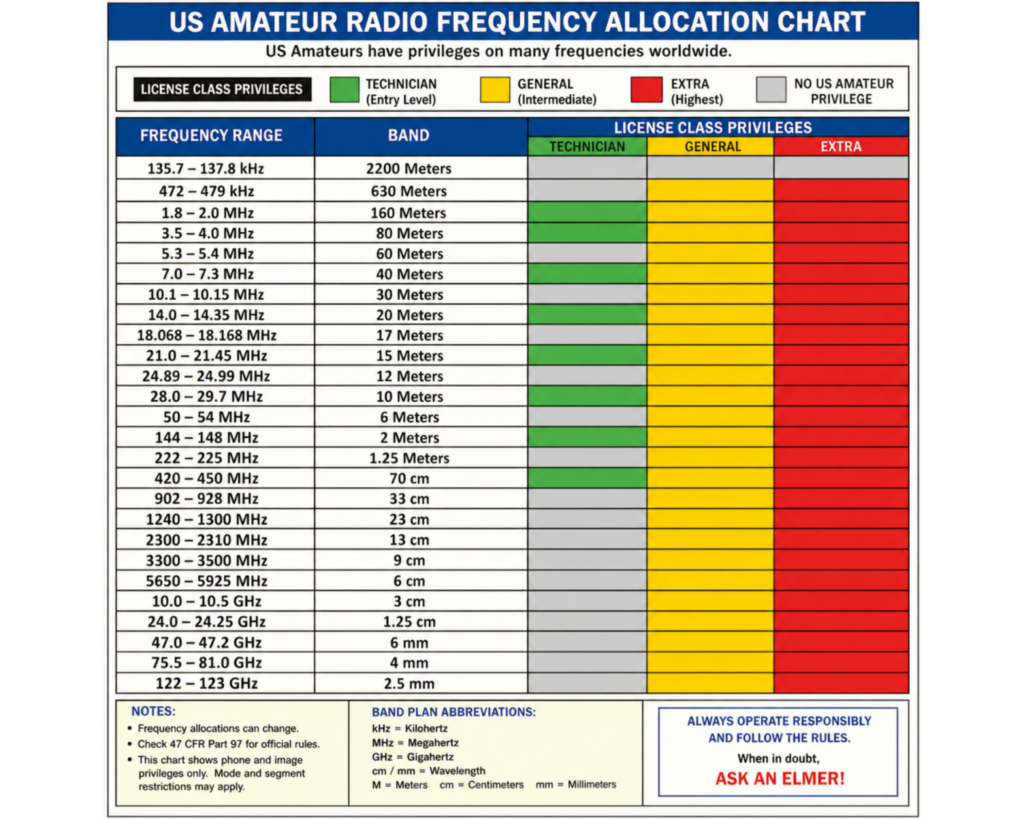
Ham radio frequencies in the United States span a wide range of the radio spectrum, from HF bands used for regional and long-distance communication to VHF and UHF bands commonly used for local contacts, repeaters, satellites, and other amateur radio activities.
But there is no single “ham radio frequency.”
Instead, the FCC authorizes amateur radio operation within specific frequency bands, and the frequencies an operator may use depend on factors including license class, band, operating mode, and applicable regulations. ARRL band plans provide additional voluntary guidance for how different portions of those bands are commonly used.
This guide provides a practical introduction to US ham radio frequencies, amateur radio bands, common operating frequencies, HF/VHF/UHF differences, simplex and repeater operation, and ways to find frequencies used in your local area.
Important: Frequency privileges and regulations can change. Always verify current FCC rules and current band-plan information before transmitting.
What Are Ham Radio Frequencies?
Ham radio frequencies are frequencies within portions of the radio spectrum allocated for use by the Amateur Radio Service.
Rather than operating anywhere on the spectrum, licensed amateur radio operators transmit within authorized bands.
For example, US amateur allocations include:
- 2 meters: 144–148 MHz
- 1.25 meters: 222–225 MHz
- 70 centimeters: 420–450 MHz
- 33 centimeters: 902–928 MHz
- 23 centimeters: 1240–1300 MHz
Additional amateur allocations extend through HF, microwave, millimeter-wave spectrum and frequencies above 275 GHz.
Frequency vs. Band: What’s the Difference?
A frequency is a specific point in the radio spectrum, such as:
146.520 MHz
A band is a range of frequencies. For example, the US 2-meter amateur band covers:
144–148 MHz.
This distinction becomes important when reading amateur radio frequency charts.
A chart might show the entire 2-meter allocation, while a band plan provides more detailed recommendations for how portions of that spectrum are commonly used.
US Amateur Radio Bands at a Glance
Amateur radio encompasses considerably more spectrum than the familiar 2-meter and 70-centimeter bands.
For a beginner, however, it helps to start with three broad frequency regions:
| Frequency Region | General Range | Common Amateur Uses |
|---|---|---|
| HF | 3–30 MHz | Regional and long-distance communication, DX, CW, voice and digital operation |
| VHF | 30–300 MHz | Local/regional communication, repeaters, simplex, weak-signal and satellite activity |
| UHF | 300 MHz–3 GHz | Local communication, repeaters, simplex, satellites and other specialized operation |
These descriptions are intentionally general. Actual communication range depends on frequency, propagation, antenna system, terrain, power, operating mode and many other factors.
Common US Amateur Radio Bands
Some of the best-known amateur bands include:
| Amateur Band | Frequency Range |
|---|---|
| 160 meters | 1.800–2.000 MHz |
| 80 meters | 3.500–4.000 MHz |
| 60 meters | Special channels plus 5351.5–5366.5 kHz segment* |
| 40 meters | 7.000–7.300 MHz |
| 30 meters | 10.100–10.150 MHz |
| 20 meters | 14.000–14.350 MHz |
| 17 meters | 18.068–18.168 MHz |
| 15 meters | 21.000–21.450 MHz |
| 12 meters | 24.890–24.990 MHz |
| 10 meters | 28.000–29.700 MHz |
| 6 meters | 50–54 MHz |
| 2 meters | 144–148 MHz |
| 1.25 meters | 222–225 MHz |
| 70 centimeters | 420–450 MHz |
| 33 centimeters | 902–928 MHz |
| 23 centimeters | 1240–1300 MHz |
The ARRL US amateur band chart provides the detailed license-class, mode and band-segment information operators need before transmitting.
* 60 meters deserves special attention. New US privileges took effect February 13, 2026. General, Advanced and Amateur Extra operators now have access to four specified channels plus the 5351.5–5366.5 kHz segment, with different power restrictions applying to the channels and the new segment. Operators should consult the current rules rather than relying on older frequency charts.
HF Ham Radio Frequencies
HF, or High Frequency, spans 3–30 MHz.
Many of amateur radio’s best-known bands fall within or around this portion of the spectrum, including:
- 80 meters
- 60 meters
- 40 meters
- 30 meters
- 20 meters
- 17 meters
- 15 meters
- 12 meters
- 10 meters
HF is especially important to amateur operators because signals can sometimes travel far beyond line of sight through ionospheric propagation.
Depending on the band and current propagation conditions, HF can support contacts ranging from relatively nearby stations to stations thousands of miles away.
Propagation changes with factors including:
- time of day,
- season,
- solar activity,
- frequency,
- antenna characteristics,
- and current ionospheric conditions.
For that reason, statements such as “20 meters is for long distance” or “40 meters is a nighttime band” are useful only as broad rules of thumb—not guarantees.
VHF Ham Radio Frequencies
VHF, or Very High Frequency, covers 30–300 MHz.
Two particularly familiar US amateur allocations in this range are:
6 meters: 50–54 MHz
2 meters: 144–148 MHz.
VHF is widely used for:
- local simplex contacts,
- FM repeater operation,
- club and community nets,
- weak-signal operation,
- satellite communication,
- public-service activities,
- and other local or regional communication.
Unlike typical HF propagation, much VHF activity relies more heavily on direct and terrain-influenced propagation, although specialized propagation conditions can occasionally support contacts far beyond normal local ranges.
UHF Ham Radio Frequencies
UHF, or Ultra High Frequency, covers 300 MHz–3 GHz.
Important US amateur allocations include:
70 centimeters: 420–450 MHz
33 centimeters: 902–928 MHz
23 centimeters: 1240–1300 MHz.
The 70-centimeter band is especially familiar to many operators because it is widely used for local repeaters, simplex communication and other amateur applications.
UHF signals can behave differently from VHF signals around buildings and terrain, but describing UHF simply as “short-range radio” is misleading. Range depends heavily on antenna height, terrain, system design, repeaters and propagation conditions.
Ham Radio Frequency Chart: How to Read One
A US ham radio frequency chart typically provides more information than just the edges of each band.
Depending on the chart, it may show:
- amateur band limits,
- license-class privileges,
- operating modes,
- subbands,
- power restrictions,
- and special regulatory notes.
This is particularly important on HF because Technician, General and Amateur Extra operators do not necessarily have identical privileges within every band.
The current ARRL US band chart, for example, identifies privileges for Technician, General, Advanced and Amateur Extra operators and includes mode and power information.
Don’t Confuse a Frequency Allocation With a Band Plan
This distinction is important.
FCC allocations and privileges are regulatory.
They determine where an amateur station is legally authorized to transmit and under what conditions.
An ARRL band plan, on the other hand, provides voluntary operating recommendations intended to encourage efficient and compatible use of amateur spectrum.
ARRL explicitly describes its national band plans as recommendations and notes that regional frequency-coordination practices may differ where local conditions require them.
So:
FCC rules → legal authority
Band plans → recommended operating practice
Both matter, but they are not the same thing.
Common Ham Radio Frequencies
One of the most common beginner questions is:
“What frequency do ham radio operators use?”
There isn’t one universal answer.
Operators select frequencies according to the band, license privileges, operating mode, local activity and purpose of the contact.
However, certain frequencies and portions of bands have recognized uses.
146.520 MHz — National Simplex Calling Frequency
One particularly useful example is:
146.520 MHz
ARRL’s current 2-meter band plan identifies 146.520 MHz as the National Simplex Calling Frequency.
This is within the US 2-meter amateur allocation of 144–148 MHz.
The surrounding band contains many other recommended uses, including weak-signal operation, satellite activity, repeater inputs and outputs, and simplex operation.
That is why it is better to understand the band plan rather than memorize a random list of frequencies.
2 Meter Ham Radio Frequencies
The 2-meter band is one of the most recognizable amateur radio bands in the United States.
Its US allocation is:
144.000–148.000 MHz.
ARRL’s national 2-meter band plan divides that spectrum into recommended areas for activities including:
- weak-signal and CW operation,
- SSB,
- propagation beacons,
- amateur satellites,
- FM simplex,
- repeater inputs,
- repeater outputs,
- and experimental operation.
For example:
144.200 MHz is identified as a national calling frequency for SSB/weak-signal activity.
146.520 MHz is identified as the National Simplex Calling Frequency.
These are specific national recommendations. Repeater channel use, however, is much more dependent on regional coordination.
Ham Radio Simplex Frequencies
Simplex means two stations communicate directly on the same frequency without using a repeater.
For example:
Station A ↔ Station B
Both stations transmit and receive directly.
On 2 meters, ARRL’s national band plan identifies several portions of the band for simplex activity and specifically identifies 146.520 MHz as the National Simplex Calling Frequency.
Simplex is useful for:
- direct local contacts,
- portable operating,
- checking direct station-to-station coverage,
- local group communication,
- and situations where a repeater isn’t necessary or available.
The appropriate simplex frequencies can vary according to regional band plans, so local guidance should also be checked.
Repeater Frequencies: Why There Is No Single US List
Repeaters receive a signal on one frequency and retransmit it on another, often from an elevated location.
This can dramatically increase practical communication coverage.
However, it would be misleading to publish a few arbitrary repeater frequencies and describe them as universal US repeater channels.
Repeater usage is coordinated regionally.
ARRL supports regional frequency coordination and notes that local conditions can justify variations from national band-plan recommendations.
Therefore, when looking for repeaters, you generally need to know:
- your location,
- repeater output frequency,
- input offset,
- access tone or digital parameters when applicable,
- operating mode,
- and whether the repeater is currently active.
A local club, regional frequency coordinator or current repeater directory is more useful than a generic nationwide list.
How to Find Ham Radio Frequencies Near You
A search for “ham radio frequencies near me” usually means something different from a search for the US amateur band allocations.
The legal bands are national, but local activity is local.
If you want to hear or contact operators nearby, start with:
1. Local amateur radio clubs
Local clubs often know which repeaters, simplex frequencies and nets are active in the area.
2. Repeater directories
Current repeater databases can help locate nearby repeaters and provide operating information.
3. Regional frequency coordinators
Regional coordinators help manage repeater frequency usage and may publish local band plans or coordination information.
4. Listen before transmitting
Even when you know an appropriate frequency, good operating practice includes listening first to determine whether it is already in use.
License Classes and Frequency Privileges
The United States currently has three main amateur radio license classes:
Technician
General
Amateur Extra
Your license class affects where you may transmit.
Technician
Technician licensees have extensive privileges on amateur bands above 30 MHz, including familiar VHF and UHF bands such as 6 meters, 2 meters and 70 centimeters.
Technicians also have certain HF privileges, so it is inaccurate to describe Technician operation as exclusively VHF/UHF.
The exact permitted segments and modes should always be checked against the current US amateur band chart.
General
General-class operators receive substantially broader HF privileges while retaining VHF/UHF privileges.
This makes General a common upgrade for operators interested in expanding HF operation and making more long-distance contacts.
Amateur Extra
Amateur Extra provides the broadest frequency privileges available to US amateur radio operators.
Even Extra-class operators must still comply with band-specific mode, power, sharing and other regulatory restrictions.
For all three classes, a current band chart is more reliable than memorizing frequency limits from an old article.
Important Rules Before Transmitting
Knowing that a frequency falls inside an amateur band is not always enough.
Before transmitting, an operator should consider:
- license-class privileges,
- permitted modes,
- band edges,
- bandwidth restrictions,
- power limits,
- frequency-sharing requirements,
- regional band plans,
- and whether the frequency is already occupied.
Some bands also have special requirements.
The 60-meter rules are an excellent current example.
The 2026 US 60-Meter Changes
US amateur privileges on 60 meters changed effective February 13, 2026.
Under the new framework, General, Advanced and Amateur Extra operators may use four specified channels and the 5351.5–5366.5 kHz segment.
The four channel carrier frequencies listed by ARRL are:
- 5330.5 kHz
- 5346.5 kHz
- 5371.5 kHz
- 5403.5 kHz
Different power limits apply to the channels and the 15-kHz segment. The new 5351.5–5366.5 kHz segment is limited to 9.15 W ERP, while the specified channels permit up to 100 W ERP, subject to the applicable rules.
This is precisely why old frequency charts should not be treated as permanent references.
HF, VHF and UHF: Which Should You Use?
There isn’t a universally “best” ham radio band.
The appropriate band depends on what you want to do.
For long-distance contacts
HF is generally the starting point for operators interested in DX and ionospheric propagation.
If you enjoy confirming memorable DX contacts, our Ham Radio QSL Cards Guide explains what QSL cards mean, what information to include, common sizes, and how operators exchange confirmations.
For local communication
2-meter VHF and 70-centimeter UHF are widely used for local simplex and repeater communication.
For repeaters
Both VHF and UHF are widely used, depending on local repeater infrastructure and coordination.
For portable operating
HF, VHF and UHF can all be useful depending on the operating objective, equipment, antenna and location.
Planning to operate from a park? See our POTA Activation Checklist for a practical guide to equipment, antennas, logging, spotting, and field setup.
The important point is that frequency alone does not determine range.
Propagation, antenna height and efficiency, terrain, power, mode and environmental conditions all matter.
Frequently Asked Questions About Ham Radio Frequencies
What frequencies do ham radios use?
US amateur radio operators have access to numerous FCC-authorized bands across HF, VHF, UHF and higher-frequency spectrum. Examples include 1.8–2.0 MHz on 160 meters, 14.0–14.35 MHz on 20 meters, 144–148 MHz on 2 meters and 420–450 MHz on 70 centimeters. Exact transmitting privileges depend on license class and applicable regulations.
What is the most common ham radio frequency?
There is no single most common ham radio frequency for every type of operation. However, 146.520 MHz is particularly well known because ARRL identifies it as the National Simplex Calling Frequency on the 2-meter band.
What is the 2 meter ham radio frequency range?
In the United States, the 2-meter amateur radio band extends from 144 to 148 MHz.
What is the difference between HF, VHF and UHF?
HF, VHF and UHF describe different portions of the radio-frequency spectrum. HF is commonly associated with ionospheric and long-distance amateur communication, while VHF and UHF are widely used for local/regional communication, repeaters and specialized amateur activities. Actual range varies significantly with propagation, terrain, antennas and station configuration.
What frequencies can a Technician use?
Technician licensees have extensive amateur privileges above 30 MHz as well as specific privileges on portions of certain HF bands. Because the allowed modes and frequency segments matter, operators should consult the current US amateur band chart rather than relying on a simplified list.
How do I find ham radio frequencies near me?
Start with local amateur radio clubs, current repeater directories and your regional frequency-coordination organization. Local repeater and simplex activity varies geographically, even though the underlying FCC amateur allocations apply nationally.
Keep a Current Frequency Reference at Your Station
Ham radio frequency information is much easier to use when you have a current band reference available while operating.
A useful reference should help you quickly identify:
- band edges,
- license privileges,
- commonly used band segments,
- operating modes,
- and important restrictions.
Because regulations and allocations can change, always compare reference material with current FCC rules and authoritative amateur-radio sources before transmitting.
Looking for practical ham radio station references?
Explore Bilmiss station and desk accessories designed for amateur radio operators.
→ Bilmiss Station & Desk Accessories
Official Ham Radio Frequency Resources
For current US frequency and regulatory information, use authoritative sources including:
FCC Amateur Radio Service — Part 97
The legal foundation for US amateur radio operation.
ARRL US Amateur Radio Bands
A detailed visual reference showing current amateur bands, license privileges, modes and restrictions.
ARRL Band Plan
Recommended operating practices and common uses within amateur bands.
These should take precedence over old charts, forum posts, social-media graphics or frequency lists whose publication dates and sources cannot be verified.