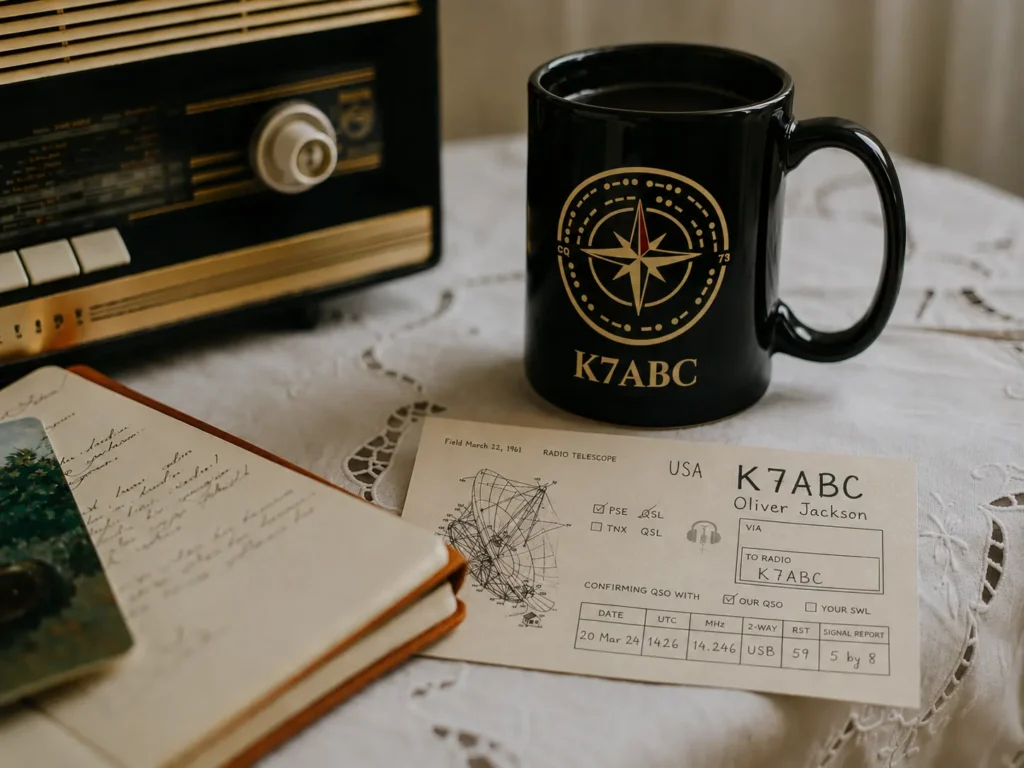
Ham radio QSL cards are confirmation postcards that document a two-way contact you made on the air. In practice, they’re used to verify a QSO (a “contact” between two amateur radio stations) for awards, to build a personal station record, and simply to exchange a memorable, tangible memento with another operator.
In this guide to ham radio QSL cards, you’ll learn what QSL means, how QSL cards work, what information to include, common card sizes, design and printing options, and how operators exchange physical and electronic confirmations.
A physical ham radio QSL card used to record and confirm a two-way amateur radio contact.
What Does QSL Mean in Ham Radio?
QSL is a Q-code (a standardized shorthand used in radio communications) meaning “I acknowledge receipt” or “I confirm”. In everyday terms, it’s about confirmation: “Yes, I got your transmission,” or “Yes, we made that contact.”
It’s important to separate:
-
“QSL” (the code/confirmation concept): an acknowledgement that a QSO happened.
-
The confirmation method: a QSL card (paper), or an electronic confirmation such as Logbook of The World confirmation (LoTW) or eQSL vs LoTW options.
So, the meaning of QSL (or qsl meaning) is the acknowledgment, while a qsl card (or digital record) is the proof you exchange or upload to document it.
What Is a Ham Radio QSL Card?
A ham radio QSL card is a printed card—usually postcard-sized—sent between amateur radio operators to confirm a QSO. You’ll also hear them called qsl cards for ham radio, qsl ham radio cards, amateur radio qsl cards, or simply qsl cards.
A QSL card typically includes:
-
Your station identity (your callsign, meaning your FCC-issued station identifier)
-
The other station’s callsign
-
When and where the QSO happened (date/time in UTC, “Coordinated Universal Time,” the standard time reference used in logging)
-
What band/frequency/mode you used
-
Signal reports and any notes
For some operators, the main point is awards or recordkeeping; for others, it’s the tradition and the “postcard from the airwaves” feel.
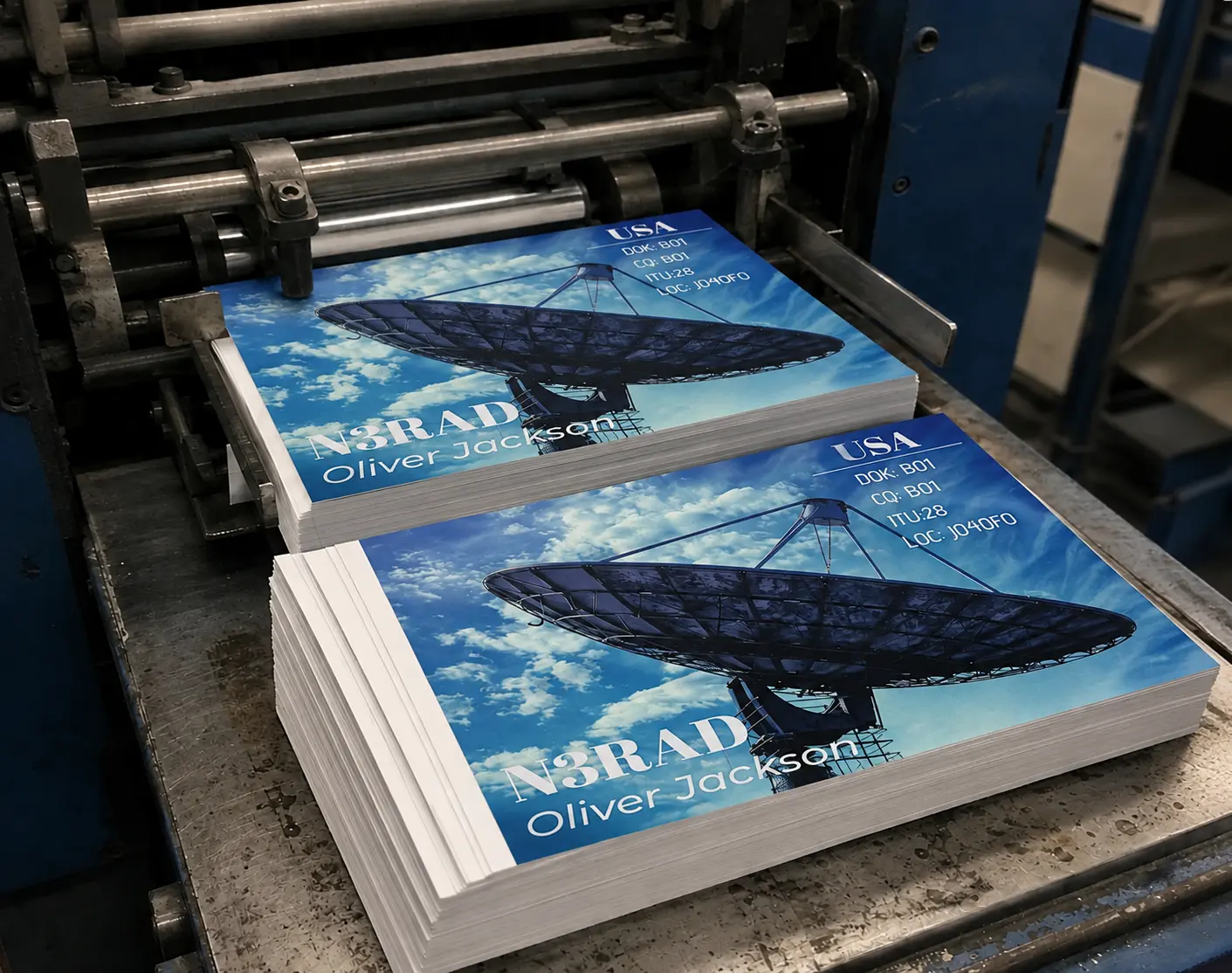
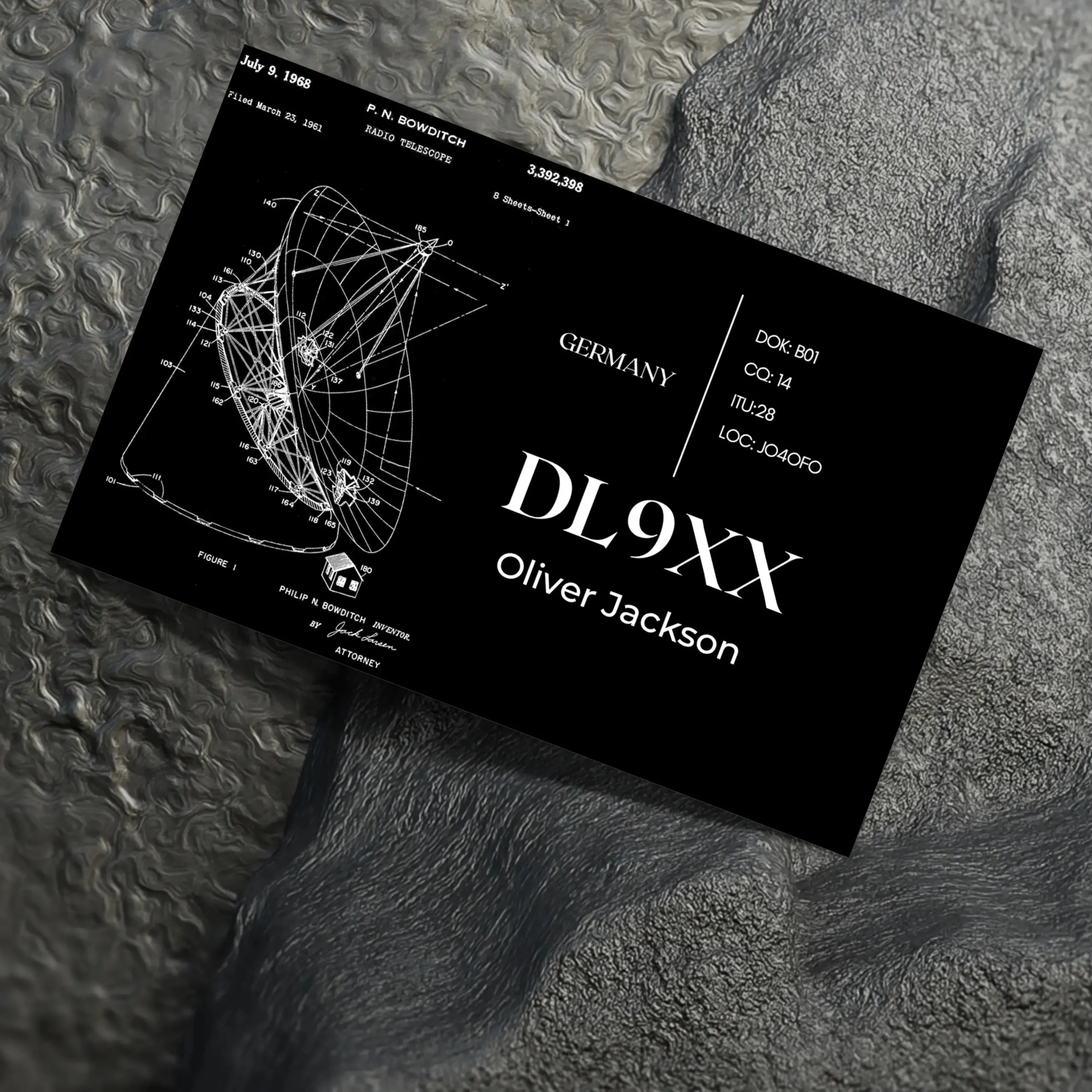 Example of a personalized ham radio QSL card featuring a callsign and station information.
How Ham Radio QSL Cards Work (From Contact to Confirmation)
A QSL card is basically the paper version of what your log already says—but shared and agreed upon by both stations.
Typical workflow:
-
Make the QSO (two-way contact).
-
Log the details in your station log (paper or software).
-
Decide whether to request or send a card (not every QSO needs one).
-
Exchange confirmations by:
-
Mailing cards direct
-
Sending via a QSL bureau (a bulk mail forwarding service run by amateur radio organizations)
-
Using electronic systems like LoTW or eQSL
-
When someone asks what is a QSL card, the most accurate answer is: it’s a confirmation artifact. The “proof” part matters most when you’re pursuing an award with documentation rules.
Legal vs awards vs “common practice”
-
FCC (legal/regulatory): The FCC governs identification and operating rules, but it generally doesn’t require you to exchange QSL cards for normal operation.
-
ARRL (organizational/awards): Many awards have specific confirmation requirements (often LoTW and/or physical cards).
-
Common practice/tradition: Many operators exchange QSLs for DX, special events, first contacts on a new band/mode, or memorable QSOs—purely optional.
QSL Card Info to Include (And Why It Matters)
If you want your cards to be useful—especially if they might be used for awards—focus on accuracy and clarity. Here’s the core QSL card info to include.
Must-have contact fields
Include these as clearly labeled fields:
-
To radio / Confirming station callsign: the other operator’s callsign
-
From callsign: your callsign (your station identifier)
-
Date: use an unambiguous format (many use YYYY-MM-DD)
-
Time (UTC): define it as UTC on the card so nobody confuses local time
-
Band: the amateur band (for example “20 m”)—band means a named slice of spectrum allocated to amateur radio. Not sure which amateur bands and frequencies apply? See our Ham Radio Frequency Guide for a practical overview of U.S. amateur radio bands, frequencies, and operating privileges.
-
Frequency: optional but helpful—frequency is the exact operating frequency in MHz
-
Mode: mode means the type of emission/communications method (SSB, CW, FT8, etc.)
-
Signal report: a sent/received report; on voice you often see RST style reports—signal report is a standardized readability/strength/tone-type rating (format depends on mode)
Strongly recommended fields
-
Your QTH: your station location (city/state; grid square if you like)
-
Other station’s QTH: sometimes left blank, but a spot to note it can be useful
-
Power and antenna (PWR/ANT): optional details many operators appreciate
-
Rig: optional radio model
-
Operator name: optional
-
Remarks: “First QSO on 6m,” “Field Day,” “POTA,” etc.
-
QSL message/check boxes: common checkboxes include “TNX QSO,” “PSE QSL,” “QSL via bureau,” “Direct,” or “Verified in LoTW”
Design tip: make “the log line” impossible to misread
Awards checking (and operator sanity) improves when:
-
Fields are grouped like a log entry
-
Fonts are readable
-
There’s room to write neatly (or print a label)
If you’re building a template, aim for a layout that helps the other station confirm quickly.
Standard QSL Card Size (US-Friendly Options)
The standard QSL card size varies by region and by how you plan to exchange.
Common sizes:
-
US postcard size: about 4 in × 6 in (popular because it mails easily in the US)
-
Classic “bureau-style” sizes: many operators use sizes that fit common bureau sorting and storage, often around 3.5 in × 5.5 in (varies—always confirm with your printer and your planned exchange method)
-
Oversize cards: look great, but can increase postage and be less bureau-friendly
Practical guidance:
-
If you plan mostly US direct mail, 4×6 is simple and widely supported by printers.
-
If you plan heavy ARRL outgoing QSL bureau use, choose a size and thickness that handles bulk sorting and keeps weight down.
Templates: DIY Layouts and QSL Card Templates for Printing
If you’re not sure where to start, use QSL card templates for printing—then customize.
Template options:
-
Graphic design tools: Canva/Illustrator/Inkscape (good for custom layouts)
-
Photo editors: Photoshop/GIMP (great for photo-front designs)
-
Ham logging software exports: some let you generate QSL labels or card fields
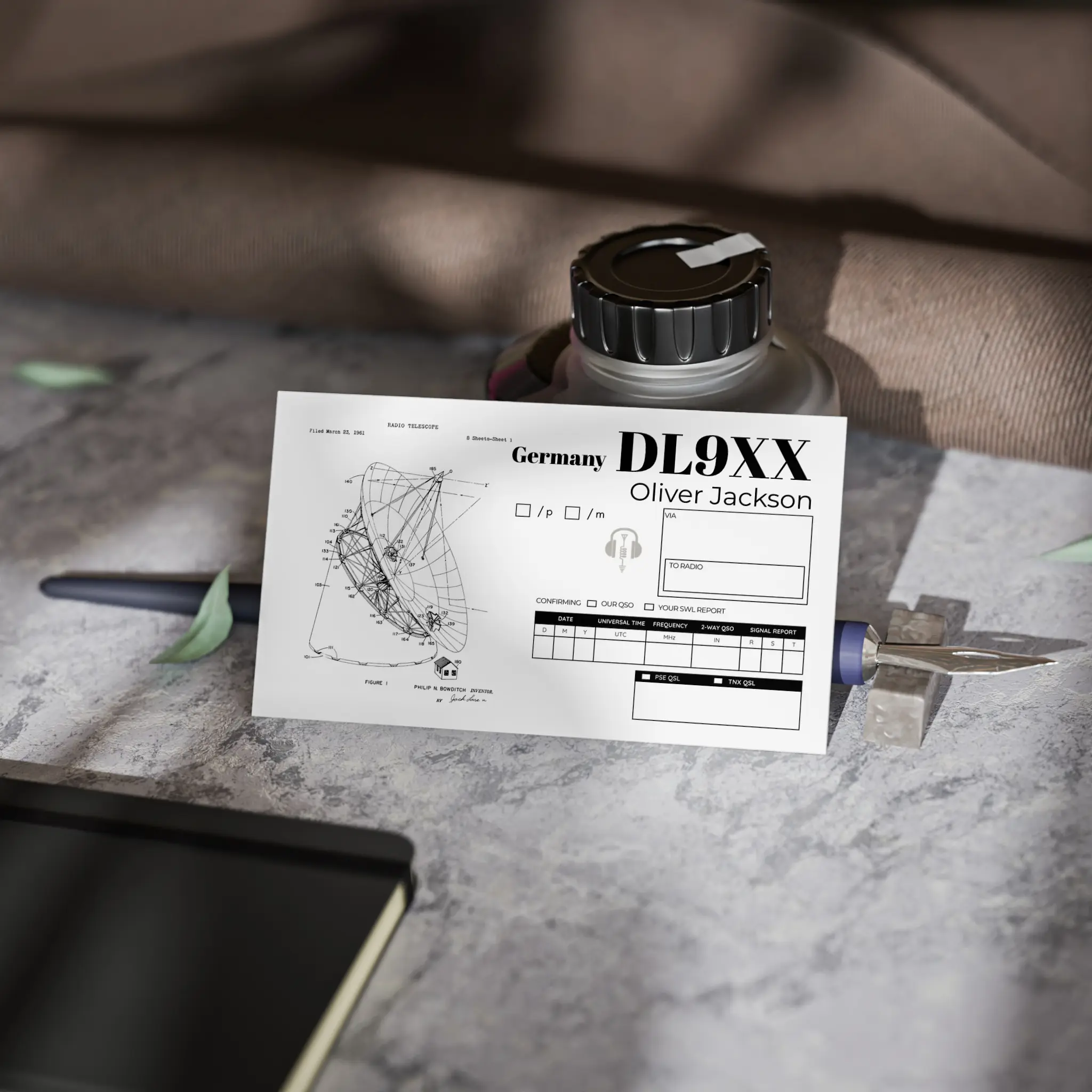
What your template should include:
-
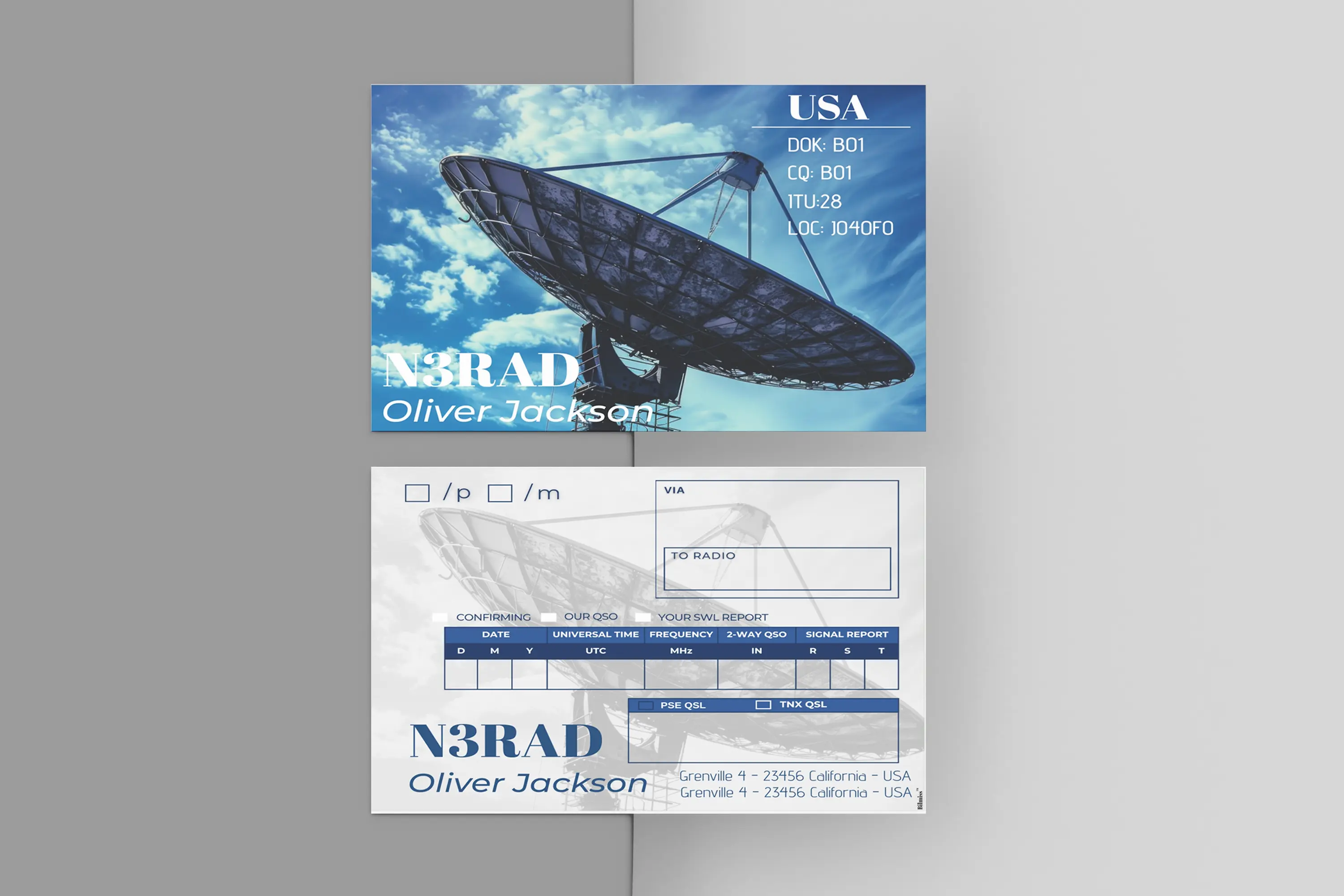
A front area for branding (photo, shack, antenna, local landmark, or a clean graphic)
-
A back (or lower section) with the QSO confirmation grid
-
A clear “Confirming QSO with: _” line (helps reduce mis-sends)
Custom QSL card design ideas that still stay practical
-
Your station photo + a simple callsign banner
-
A map outline of your state with your QTH marked
-
A minimal “modern” design with high contrast and big callsign
-
A theme tied to your operating style (portable ops, satellites, contesting)
Avoid clutter: a busy card can become hard to fill out and verify.
Design and Printing Options (From Home Printer to Pro Services)
Your print choice affects cost, durability, and how “premium” the card feels.
Best paper for QSL cards (and card stock basics)
For physical cards, a stiff stock helps them survive handling and mail:
-
Cardstock / cover stock is common
-
Consider matte for easier writing (gloss can smear with some pens)
-
If you want photo fronts, semi-gloss can look great—but test your pen on the back
“Best paper for QSL cards” depends on your method:
-
Direct mail: sturdier stock is fine
-
Bureau: slightly lighter stock can reduce weight and bulk, but don’t go flimsy
Printing routes
-
Print at home
-
Pros: fastest, flexible, easy for small batches
-
Cons: color consistency, ink cost, trimming effort
-
-
Local print shop
-
Pros: good quality control, paper options, quick turnaround
-
Cons: may be pricier for small runs
-
-
Online printers
-
Pros: economical in bulk, professional look, easy reorders
-
Cons: you need a press-ready file, shipping time
-
If you’re searching for QSL card printing services USA, compare:
-
Supported sizes (especially 4×6)
-
Paper weights and finishes
-
Whether they print true postcards (with a writable back)
-
Color accuracy and proofs
Labels vs handwritten vs printed fields
-
Handwritten: personal, but readability varies
-
Printed labels: fast and consistent—popular for DX-heavy stations
-
Direct-to-card printing: looks sharp if aligned correctly
A practical hybrid: print the front and static back fields professionally, then use labels or neat handwriting for the QSO line.
Prefer a ready-made personalized option? Explore Bilmiss Personalized Ham Radio QSL Cards, customized with your callsign and station details.
How to Exchange QSL Cards (Direct, Bureau, and Electronic)
Operators commonly ask how to exchange QSL cards because there isn’t a single “right” way—just what fits your goals.
1) Direct QSL (mail-to-mail)
Direct is exactly what it sounds like: you mail a card to the other operator’s address (often found on QRZ-like listings or provided by the station).
Typical “direct” best practices (common practice, not law):
-
Include your QSL card and a short note if needed
-
Provide return postage support if requesting a reply
Direct QSL with SASE: In the US, a common method is including a SASE (Self-Addressed Stamped Envelope) so the other operator can easily mail your reply. For international, many operators use different conventions, and costs can vary widely—always check what the other station prefers before sending cash or anything sensitive.
When you’re thinking how to request QSL card directly, the simplest approach is:
-
Send your card
-
Clearly write “PSE QSL” and specify return route (direct, bureau, or LoTW)
-
Include return support (SASE) if you want a physical reply
2) QSL bureau vs direct (bulk forwarding)
A QSL bureau is a centralized forwarding service that collects cards in bulk and ships them in batches to reduce cost. This is slower than direct mail, but cheaper per card for high volume.
Two common categories:
-
Outgoing bureau: you send your cards to a bureau that forwards them to the destination country/region
-
Incoming bureau: your bureau receives bundles for you and distributes them to you (often via your call area)
For US operators, the ARRL outgoing QSL bureau is the best-known option for bureau-based outgoing cards (check ARRL’s current procedures and packaging guidance, since details can change).
Bureau tips:
-
Use a bureau-friendly size and thickness
-
Sort as required by the bureau’s current instructions
-
Expect time delays—bureau routes can take months
3) Electronic: LoTW and eQSL
Physical cards aren’t the only confirmations anymore.
Logbook of The World confirmation (LoTW):
-
Operated by ARRL
-
You upload signed log data; matches confirm QSOs
-
Strongly tied to ARRL award ecosystems and widely accepted for many confirmations
eQSL vs LoTW:
-
eQSL provides electronic QSL “cards” (visual, shareable) and confirmations inside its system
-
LoTW is more log-centric and award-integrated for many operators
Many stations do both:
-
LoTW for award-grade confirmation workflow
-
eQSL for quick “card-like” swaps and easy sharing
-
Physical cards for special contacts, DX, or personal tradition
Physical vs Electronic Confirmations: Choosing What Fits Your Goals
Think in terms of what you’re trying to accomplish.
Physical QSL cards are best for:
-
Sentimental value and collecting
-
Displaying memorable DX, contests, events, firsts
-
Operators who enjoy the tradition of exchanging postcards
If portable operating is part of your ham radio activity, our POTA Activation Checklist covers equipment, antennas, logging, spotting, and practical field operating tips.
Electronic confirmations are best for:
-
Speed (near-instant matching)
-
High-volume operating (contests, FT8 activity)
-
Award tracking without postage and storage
A balanced approach is common: use LoTW as your “official” confirmation trail, and send physical cards when it’s meaningful or requested.
Common Problems (and How to Fix Them)
QSL card received but incorrect: what to do
If you receive a QSL card received but incorrect (wrong band, time, date, callsign typo, mode mismatch):
-
First, verify your log (including UTC date rollovers—many mistakes happen around 0000 UTC).
-
If it’s a small typo but the contact is clearly identifiable, decide whether it matters for your purpose (some awards are strict).
-
Politely contact the operator with specifics:
-
Your callsign
-
Their callsign
-
The QSO details from your log (UTC date/time, band, mode)
-
What appears incorrect on the card
-
-
Ask for a corrected card or for confirmation via LoTW/eQSL if that meets your needs.
Keep it friendly—most errors are honest logging or transcription issues.
Lost mail, no reply, or slow bureau
Non-replies happen. Common reasons:
-
Operator only confirms via LoTW
-
Address changes
-
Bureau backlog
-
The station is inactive
If you really need confirmation for an award, consider whether LoTW is available or whether another contact with that station is likely.
Practical Tips for Better QSL Success
-
State your preference in your online listings: “QSL via LoTW,” “Direct OK,” “Bureau OK,” etc.
-
Use UTC on your card and log: avoids date confusion.
-
Be consistent with mode naming: e.g., “SSB,” “CW,” “FT8.”
-
Keep a small stock of international postage strategies: but follow the other operator’s preference and keep it simple.
-
Don’t over-send: many modern operators confirm electronically and don’t want piles of unsolicited cards.
Conclusion: Why Ham Radio QSL Cards Still Matter
Even with fast digital confirmations, ham radio qsl cards remain a practical way to document a QSO and a long-standing tradition that many operators enjoy. Whether you use physical cards for special contacts, rely on Logbook of The World confirmation for awards, compare eQSL vs LoTW for your workflow, or mix direct and QSL bureau vs directexchanges, the best approach is the one that matches your operating style and goals—while keeping confirmations accurate, readable, and easy to process.
FAQ
What does QSL mean in ham radio?
QSL is a Q-code meaning “I acknowledge receipt” or “I confirm.” It refers to confirming a contact, not specifically to a card.
What is a ham radio QSL card?
A ham radio QSL card is a postcard-style card exchanged between stations to confirm a QSO with logged details (callsigns, UTC time/date, band, mode, etc.).
What information should be on a QSL card?
At minimum: both callsigns, date, time in UTC, band, mode, and a signal report. Many also include QTH, power, antenna, and remarks. (This is the key QSL card info to include.)
What size is a QSL card?
A common US-friendly standard QSL card size is about 4×6 inches, though smaller bureau-friendly sizes are also widely used.
Are QSL cards still used?
Yes. Many operators use electronic confirmations for everyday contacts, but physical cards are still exchanged for DX, special events, and personal collecting.
How do ham radio operators exchange QSL cards?
Common exchange methods (direct, bureau) include mailing cards directly (often with return support like direct QSL with SASE in the US) or using a QSL bureau. Many also confirm electronically through LoTW or eQSL.
How can I make a QSL card?
Start with a layout or QSL card templates for printing, add your callsign and QSO fields, then print at home or use online/local printers. Choose readable fonts and a writable back.
Do I need to send a QSL card after every contact?
No. There’s generally no legal requirement to exchange QSL cards for routine operating. Many operators only send them on request, for award needs, or for memorable QSO